
How to Stop Feeling Guilty About Food
Food guilt is one of the most common challenges my clients report.
Regardless of age, body size, or specific eating patterns, for so many folks, nagging food guilt is persistent and unrelenting.
It shapes what, when, and how much they choose to eat, how they feel about themselves after they eat, their ability to enjoy social events and holidays, and how they show up in their day-to-day life.
So why is food guilt so pervasive, and what can you do about it?

Where does food guilt come from?
First, let’s talk about what guilt is. According to Merriam-Webster, guilt is:
the fact of having committed a breach of conduct, especially violating law and involving a penalty;
a feeling of deserving blame for offenses.
In other words, guilt is what we feel after we know we’ve done something wrong. After we’ve violated a rule. And something for which penance should be paid.
So, to experience food guilt, there must first be food rules for you to have violated.
Often those rules relate to the type of food that we believe “should” or “shouldn’t” be eaten. But they can also pertain to the quantity of food we consume, when we eat, what we need to do to “earn” the right to eat, or a combination of all the above.
Now, depending on the person and where their food rules came from (which we’ll talk about more in a moment), the exact rules might vary. But here are some common examples to give you a sense of what I’m talking about.
Ice cream is off limits.
I can only eat ice cream on days I go to the gym.
If I eat ice cream, it must be a low-calorie option.
Ice cream is only allowed on the weekends.
I can only eat 1 serving of ice cream on the days I’m allowed to eat it.
I must have at least 30 grams of protein at each meal.
I must have a fruit or vegetable at every meal.
If I want a snack, it can only be a fruit or vegetable.
I should only eat 3 times/day.
I can’t eat lunch until at least 12:00 pm. Before 12:00 is too early.
No eating past 7:00 pm.
I’m not allowed to drink my calories.
I could go on and on, but hopefully you get the point.
Food guilt is a by-product of food rules. And the food rules we hold can be extensive and insidious. It can take quite a while to even begin recognizing the rules we hold around food as such because they are so deeply ingrained. I can’t tell you the number of times a client has shown up for a session and said something to the effect of, “I discovered another food rule that I created that I didn’t even know was there!”

Where do food rules come from?
There is no single set of universally accepted food rules. That’s because, officially, food rules aren’t real. They are personal, usually self-declared, and originate from many places.
Formal diet or eating plans.
These are perhaps the most obvious source of food rules, because they are generally presented as a strict set of instructions about precisely what, when, and/or how much to eat. A formal diet is literally a playbook with rules of engagement for food and eating.
But you may have never followed a formal diet or eating plan and still hold all sorts of food rules, because diet and wellness culture are pervasive. We are living in it whether we want to or not, and it can lead us to adopt all kinds of beliefs about how we “should” be eating. We may not even be conscious of it.
Food rules also come from:
Family and friends.
If you grew up in a household with rules about what should or shouldn’t be eaten, where foods were labeled as good or bad, and where certain foods were strictly prohibited, it’s very possible you’ve carried those beliefs and rules into adulthood.
Or if you were or are surrounded by a social circle with particular beliefs about what and how one should eat, you may have also adopted these beliefs as rules about how you should feed yourself.
The media.
Whenever I talk about food rules, it conjures memories of standing in the checkout line at the grocery store and reading all the diet- and weight-loss-related headlines on the covers of the “women’s” magazines conveniently placed along the aisle. Now, with the internet and social media, we are constantly targeted with food and nutrition information, which often is not accurate or helpful, but is convincing nonetheless.
Notably, because a lot of media is about clicks and views, even when media is reporting on nutrition research, the information is so often taken out of context or sensationalized for purposes of engagement at the expense of accuracy. This creates and perpetuates unhelpful beliefs and fuels food rules.
School.
Anyone else have any lingering food hangups from 9th grade health class? I hear a lot of folks cite this as the space where their fear of sugar and subsequent rules about consumption took root. Where they first learned about counting calories (🙋♀️) and formed the belief that high-calorie foods are “bad” and to be avoided. And perhaps a space where they watched documentaries about processed foods and the “ob*sity epidemic” and internalized the virtues of “clean eating” and thinness.
Health providers.
Dietary advice is a pretty standard part of the medical experience for a lot of folks. Unfortunately, that advice is not always the most helpful. It may be well-intended, but it is often overly generic, like, “avoid processed food,” and serves to reinforce food moralization and lead to rules like, “I shouldn’t eat processed food.” This kind of advice can end up doing a lot more harm than good.
How to challenge food rules.
The trick to not feeling guilty about food or eating is to challenge the rule that is causing the guilt in the first place. So, let’s talk about how to do that.
Step 1: Identify the rule.
When you notice feelings of guilt about food or eating start to surface, ask yourself, what is the rule I feel like I’ve broken? Similarly, if you notice you feel virtuous or morally superior for making what you perceive to be a “good” choice, this is also a food rule clue. What is the rule that is driving this decision?
To help illustrate this process, we’ll follow this scenario throughout each step:
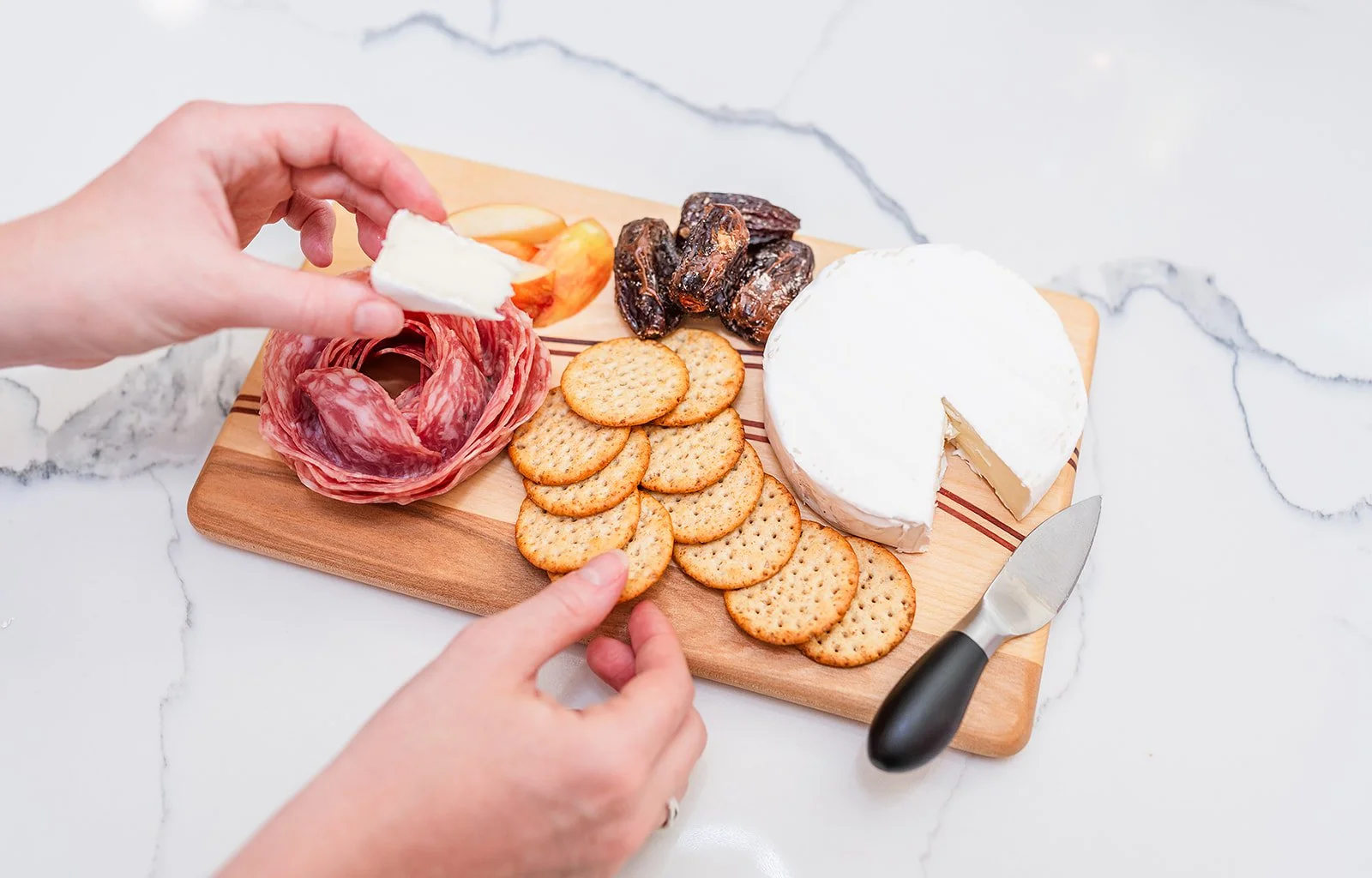
The situation: feeling guilty for eating cheese and crackers as a snack because it just looked so good when you saw your partner eating it.
The rule: If I want a snack between meals, I can only have fruit or vegetables.
So, cheese and crackers is a “bad” choice, and eating it violates the food rule.
Step 2: Where did this rule come from?
Can you recall when you decided that this was a rule you needed to follow? How did this belief develop? How reliable or credible was this source?
I created this rule when I was following a diet plan where fruit and vegetables were considered “free” foods, or didn’t count toward your daily intake limit. If I filled up on fruit and vegetables between meals, then my snacks wouldn’t take away from what I was allowed to eat at meals. I could get the most food for the lowest cost.
Step 3: How is this rule serving me?
How has holding on to this rule impacted you? How has it made you feel? Or affected how you show up in your life? How has it impacted your food choices and how you feel about food? How has it impacted how you feel about yourself?
This approach seemed like a great idea in theory. But the problem is, I don’t always feel like having fruit or vegetables for my snack. Sometimes I think I’d rather not eat at all than choke down another apple. And they just don’t hold me for very long, so I would feel constantly hungry. Then I’d feel bad for feeling hungry because ‘I just ate!’ It’s really hard to be around other people who are eating foods outside of my structured mealtimes because I so badly want to eat what they are having. But when I do, I feel so bad about myself. If I do give in, sometimes I’ll end up saying screw it and just go completely off the rails, because I’m going to start fresh tomorrow. And sometimes I feel so bad about myself after that I’ll skip my next meal to make up for it. My guilt will consume me.
Step 4: What if I didn’t have to hold this rule?
Can you remember a time before this rule existed? What was different about your experience with food/eating/your body then? What would life be like if you didn’t have this rule? What concerns do you have about letting go of it? What would be different if it didn’t exist? What would be better?
Before I created this rule, there really wasn’t any rhyme or reason to my snack choices. I ate whatever was easy and accessible and usually didn’t choose the healthiest options. I don’t think that was the best approach either, but my snacks sure did taste better. I miss being able to have more variety and not spending so much of my time thinking about and feeling guilty about my food choices. But I’m worried that if I don’t have a rule, I will make unhealthy choices.
Step 5: How can I reframe this experience?
When we reframe an experience, the goal is to present ourselves with a more neutral way of viewing it. It doesn’t mean that we have to convince ourselves to be happy about how a situation went, or not care if something didn’t go as planned or desired. But rather, can we frame the situation for what it was without attaching so much moral value or judgment to it?
So, in the scenario we’ve been following, that might look like:
I’m allowed to honor my preferences and today, cheese and crackers sounded like a much more satisfying snack than an apple or a banana. Limiting myself to just fruit and vegetables really doesn’t work for me, but that doesn’t mean I can’t be thoughtful about my choices and choose snacks that both sound good and nourish my body well. Maybe I just don’t need a rule to do that. Besides, I tend to want to rebel against my food rules anyway and then just feel bad about myself for not following them.

I spend so much time in session with clients working through their food rules just like this.
For sure, challenging old belief systems and rewriting unhelpful narratives we’ve just accepted as true for so long is hard work. Change doesn’t happen overnight.
But change does happen.
So, next time food guilt starts to wriggle its way in, maybe see what it’s like to replace that self-criticism with curiosity and see what you notice. It might be pretty illuminating!
And know that I believe you are capable of making supportive food decisions without relying on a set of food rules to dictate those decisions for you.